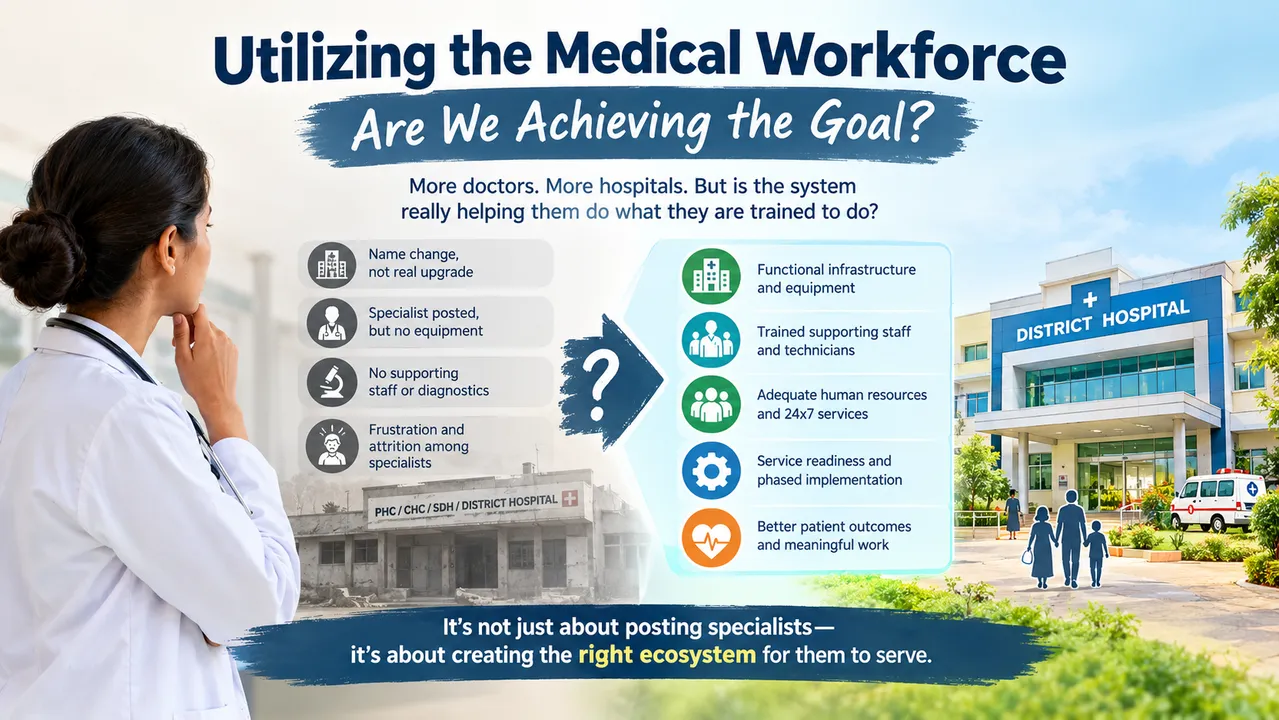
India is producing more doctors, opening more medical colleges, upgrading more health facilities and appointing more specialists. But an important question remains: are we actually creating a health system in which these doctors can use their skills effectively?
Health is one of the most important responsibilities of any government. Along with food, shelter, employment and education, access to healthcare remains a fundamental component of public welfare. India has therefore made substantial investments in expanding its public healthcare system, increasing medical education capacity and strengthening health infrastructure.
The scale of expansion is significant. According to the Government of India, the number of medical colleges increased from 387 in 2014 to 818, while undergraduate medical seats increased from 51,348 to 1,28,875 over the same period. The government has also reported 13,88,185 registered allopathic doctors, with an estimated doctor-population ratio of 1:811 when 80% availability is assumed. (Press Information Bureau)
As of March 2023, India had roughly 31,882 PHCs, 6,359 CHCs, 1,340 SDHs, 714 District Hospitals and 362 medical colleges, staffed by over 45,000 doctors and specialists at SDHs/District Hospitals and 26,000+ at CHCs. (Press Information Bureau)
These numbers represent a major expansion. But numbers alone do not provide healthcare. The more difficult question is:
Are we utilizing the medical workforce that we already have to its full potential?
A hospital is more than a building and a doctor
One of the important changes in India’s healthcare system has been the expansion and upgrading of existing facilities.
PHCs are being upgraded into CHCs, CHCs into SDH, and SDHs/District Hospitals strengthened. Under PM-ABHIM, thousands of facilities—including 744 Integrated Public Health Laboratories and 621 Critical Care Blocks—have received administrative approval as of 2025. (Press Information Bureau)
This is important progress. However, upgrading a facility on paper is not the same as making it functionally capable of providing the services expected from it. The Government’s own Indian Public Health Standards (IPHS) 2022 recognize this principle. The guidelines do not define a facility merely by its building or name. Service delivery is supposed to determine the requirements for infrastructure, human resources, drugs, diagnostics, equipment, quality improvement, monitoring and governance. (National Health Mission)
A CHC with a specialist but without the equipment, nursing staff, diagnostics and support services required by that specialist is not equivalent to a fully functional specialist facility.
The “Trauma Centre” with an orthopaedic surgeon
Imagine a government hospital that has recently been designated or upgraded as a trauma centre. An orthopaedic surgeon is posted there. On paper, this looks like an excellent development.
But then the surgeon discovers that: the X-ray machine is non-functional or unavailable, no C-arm, no adequately equipped orthopaedic OT, no trained OT assistant and nurses, essential implants and consumables are unavailable, anaesthesia support is not available round the clock, blood-bank support is distant or unreliable, and there is no adequate emergency team.
What exactly is the orthopaedic surgeon expected to do?
A patient with a fracture arrives. The surgeon examines the patient, perhaps applies a splint, gives analgesics and advises referral to a higher centre. The same thing happens again. And again. The surgeon’s qualification may say orthopaedic surgeon, but the facility’s capability effectively says referral centre.
A paediatrician without paediatric support
Consider another example. A paediatrician is posted to a First Referral Unit or Sub-District Hospital.
A distressed newborn arrives.
The paediatrician may be trained to manage neonatal emergencies, but the facility may lack: functional neonatal resuscitation equipment, adequate neonatal beds, nicu trained nursing staff, continuous oxygen supply, CPAP or ventilatory equipment, essential neonatal drugs, laboratory support, blood-gas or other necessary diagnostics, and adequate doctors to provide continuous 24-hour coverage.
Even relatively common conditions can become difficult to manage. A newborn with significant jaundice may require phototherapy, A child with dehydration or acute kidney injury requiring careful fluid management and monitoring, A child with respiratory distress may require oxygen, non-invasive ventilation. The pediatrician even being able to manage these situations, forced to refer the patients and remain sitting there as a shunting officer sending patients away.
A paediatrician cannot manufacture a NICU simply by being posted to the hospital. Again, the specialist exists, but the specialist service does not.

The pathologist who becomes a general duty doctor
The same problem can occur in laboratory medicine. Suppose a pathologist is posted at a Sub-District Hospital.
But the hospital does not have: adequate staining facilities, reliable sample-processing systems, proper cytology facilities, trained personnel for FNAC and Pap-smear handling, appropriate quality-control systems, or even a good-quality microscope.
What happens?
The pathologist may be placed in OPD duties or other general medical work because there is no functional pathology service to supervise.
The government has recruited a specialist. The patient has been promised specialist-level healthcare. But the system has not created the environment in which that specialist can provide it.
This is not an argument against posting specialists to smaller hospitals. It is an argument for posting specialists together with the infrastructure required to make their services meaningful.
The hidden cost of an under-equipped specialist
This creates an unusual situation. The government spends money on: Medical education → recruitment → salary → specialist posting but fails to complete the final part: functional service delivery.
The result is a paradox.
The government may have a qualified surgeon, paediatrician, physician, obstetrician, anaesthetist or pathologist physically present in a district or sub-district hospital, while the population still has to travel to a medical college or major city for treatment.

Therefore, the system may end up paying for specialist availability without achieving specialist service delivery. This distinction deserves much more attention in health policy.
The specialist doctor also becomes a victim of the system
This problem is often discussed only from the patient’s perspective. There is another side. Imagine spending years completing MBBS, postgraduate training and perhaps additional specialization. You are trained to perform surgery, manage critically ill children, diagnose difficult diseases, perform procedures or provide advanced investigations.
Then you are posted to a facility where half of the required equipment is unavailable. You repeatedly refer patients whom you know you could have treated in a properly functioning hospital.
After some time, professional frustration can develop.The doctor may begin to feel that their specialist training is going in vain. This often results in dissatisfaction, and sometimes depression among doctors.
This is not merely an anecdotal concern. A recent qualitative study involving specialist physicians working in rural healthcare facilities in Rajasthan identified inadequate workplace infrastructure, workload, limited professional opportunities and other health-system factors among issues influencing specialists’ motivation to remain in or leave rural service. The researchers described demotivation and specialist attrition as consequences of these systemic problems. (PubMed Central (PMC))
Earlier research from rural India has similarly found that doctors were demotivated by inadequate infrastructure and that limited clinical facilities restricted their ability to use their skills and serve communities. (PubMed Central (PMC))
This creates a vicious cycle:
Poor infrastructure → limited clinical work → professional frustration → reduced motivation → absenteeism/transfer/attrition → specialist shortage → increased workload on remaining doctors → poorer service delivery.
The answer is not simply to blame doctors for leaving.
The health system has to ask: Why would a highly trained specialist remain motivated in a place where the system repeatedly prevents them from practising their specialty?
Posting a specialist is not the same as creating a specialist service
This may be the central issue. A functioning specialist service requires an ecosystem. The exact requirements vary by facility level, but the principle is universal. A specialist is one component of a specialist service, not the entire service.
The government already recognizes this principle
Importantly, this is not an argument that nothing is being done. The Government has introduced several programmes specifically aimed at strengthening infrastructure.
PM-ABHIM, for example, was designed to address critical infrastructure gaps across primary, secondary and tertiary levels. Its components include Ayushman Arogya Mandirs, Block Public Health Units, Integrated Public Health Laboratories and Critical Care Blocks. (Press Information Bureau)
The IPHS 2022 framework also explicitly links service delivery with infrastructure, human resources, drugs, diagnostics and equipment. (National Health Mission)
This is the correct direction. The challenge is ensuring that facility expansion, workforce deployment and operational readiness happen together rather than as separate administrative exercises.
However, intentions should follow actions. Unfortunately many of the policies made with good intentions fail on the ground level. We need to focus on implementation of the same.
What should change?
1. Stop measuring success only by the number of facilities and doctors
We also need to measure:
- How many facilities are fully functional?
- How many are providing the services they are designated to provide?
- How many essential pieces of equipment are functional?
- How many specialist procedures are actually being performed?
- How many patients are unnecessarily referred?
The focus must move from headcount to functional capacity.
2. Upgrade the entire service package, not just the name
If a CHC is upgraded to provide specialist services, the upgrade should include a predefined package:
Infrastructure + equipment + drugs + diagnostics + nursing + technicians + specialist + support staff + maintenance + referral transport.
A hospital should ideally be declared operational for a particular service only after the minimum components are functional. A newly constructed building without functioning equipment should not be considered the same as a functional hospital.
3. Use a phased “service readiness” model
Every facility cannot become a full-fledged hospital overnight. Instead, facilities could be upgraded in stages. Only when a stage is functionally ready should the corresponding specialist workforce be deployed.
This would reduce the situation where doctors arrive months or years before the infrastructure needed to support them.
4. Create a “specialist readiness score”
A simple dashboard could assess every specialist facility.
For example:
| Component | Status |
|---|---|
| Specialist available | ✅ |
| Nursing staff adequate | ❌ |
| X-ray functional / Diagnostic adequacy | ❌ |
| OT functional | ❌ |
| Anaesthesia available | ❌ |
| Essential drugs available | ⚠️ |
| Blood support available | ❌ |
| Emergency ambulance | ✅ |
| 24-hour specialist coverage | ❌ |
Such a system would immediately show policymakers that: The problem is not always the absence of a doctor. Sometimes it is the absence of the system around the doctor.
5. Match staffing to workload—not just sanctioned posts
The number of doctors required at a facility should be linked to: population served, patient load, emergency workload, inpatient, geographic coverage, and required 24-hour services.
A hospital with one paediatrician cannot realistically provide continuous paediatric emergency care if that doctor is simultaneously expected to run OPD, supervise wards and cover emergencies every day. Workforce planning therefore needs to consider rostering and service continuity, not simply whether a post is occupied.
Research using workload-based staffing methods has specifically highlighted the mismatch between existing sanctioned norms and actual workload requirements in rural public facilities. (PubMed)
6. Develop shared specialist and diagnostic services
Every small hospital may not need every specialist or every advanced diagnostic facility permanently. Regional models could be used.
For example:
- visiting specialists on fixed days,
- hub-and-spoke specialist networks,
- district-level diagnostic hubs,
- telemedicine-supported consultations,
- shared radiology/pathology services,
- mobile diagnostic units,
- and specialist teams covering several nearby facilities.
The goal should be to ensure that the specialist’s time is directed where it produces the greatest clinical benefit.
7. Make rural postings professionally meaningful
Financial incentives are important, but money alone may not solve the problem. We should ensure such policies where the doctors do not feel trapped in their jobs.
Proper and adequate support facilities according to the specialty, reasonable working hours, proper residential facility and most importantly a transfer policy to ensure a regular career and personal growth.
We cannot expect a specialist doctor to spend his whole life staying and serving in a rural setup where he is restricted to utilize his professional capabilities due to system restrictions, and on personal level compromise education and growth of his family.
Studies of rural doctors in India have repeatedly identified infrastructure, professional development, housing, security and other working conditions as important considerations for recruitment and retention. (PubMed)
A rural posting should not mean professional stagnation. It should be possible for a doctor to build a meaningful career while serving a rural population.
8. Give specialists the opportunity to practise their specialty
This sounds obvious, but it is often overlooked. If an orthopaedic surgeon spends most of the day doing general OPD because there is no functional orthopaedic service, the system is wasting specialist training. If a pathologist has no laboratory in which to work, the system is wasting specialist training. If a paediatrician has no paediatric emergency infrastructure, the system is wasting specialist training.
This does not mean specialists should never undertake general duties when required. It means their primary deployment should ultimately allow meaningful use of their specialist competencies.
The goal should be “functional healthcare capacity”
India does not merely need more doctors. India needs more doctors who can work effectively.
It does not merely need more hospitals. It needs more functioning hospitals.
It does not merely need more specialists. It needs specialist-supported services.
And it does not merely need more medical equipment. It needs functional equipment with trained people, maintenance and supplies behind it.
The Government’s current infrastructure programmes show that substantial investments are already being made. PM-ABHIM alone has a total outlay of ₹64,180 crore for 2021–26, while the government continues to strengthen district and referral hospitals and expand medical education. (Press Information Bureau)
The next stage of health-system development therefore needs to focus increasingly on integration and utilization.
From “How many doctors?” to “What can the doctor actually do?”
This may be the more useful question for the next decade of Indian healthcare.
Instead of asking only:
How many specialists have we posted?
we should ask:
How many patients can those specialists actually treat because the system around them is functional?
Instead of asking:
How many hospitals have we upgraded?
we should ask:
What additional services became available to patients because of that upgrade?
Instead of asking:
How many beds have we added?
we should ask:
How many beds are staffed, equipped and capable of providing safe care?
And instead of asking:
Why are doctors leaving rural government service?
we should also ask:
Did we give them the infrastructure, workforce, equipment and professional environment necessary to do the job they were trained to do?
Conclusion: A specialist doctor is not a hospital
India has made remarkable progress in expanding medical education, healthcare infrastructure and the number of healthcare professionals. The challenge now is to ensure that this investment translates into usable clinical capacity.
Simply changing the designation of a PHC to a CHC, a CHC to an SDH, or an SDH to a District Hospital does not automatically create the services expected from that institution. Similarly, posting an orthopaedic surgeon does not create an orthopaedic trauma service. Posting a paediatrician does not create a paediatric emergency unit.
A doctor is one part of a healthcare system.
The real investment begins when the doctor is surrounded by the infrastructure, equipment, nurses, technicians, medicines, diagnostics, maintenance, administrative support and referral systems needed to practise effectively.
If we get this right, the benefits are much larger than simply improving doctor satisfaction.
Patients can receive treatment closer to home. Unnecessary referrals can decrease. Overcrowding at tertiary hospitals can reduce. Families can spend less money traveling to major cities.
And the government can obtain a much greater return from the money already invested in medical education and recruitment.
The objective should therefore no longer be simply “more doctors and more hospitals.”
It should be:
More functional doctors working in more functional hospitals, delivering more of the care that patients actually need.
Or else we are wasting money, time and resources in the training of doctors.
Because ultimately, the success of a healthcare system is not measured by how many doctors we employ—but by how effectively we enable those doctors to serve the people.
Discover more from The Quirky Doctor
Subscribe to get the latest posts sent to your email.