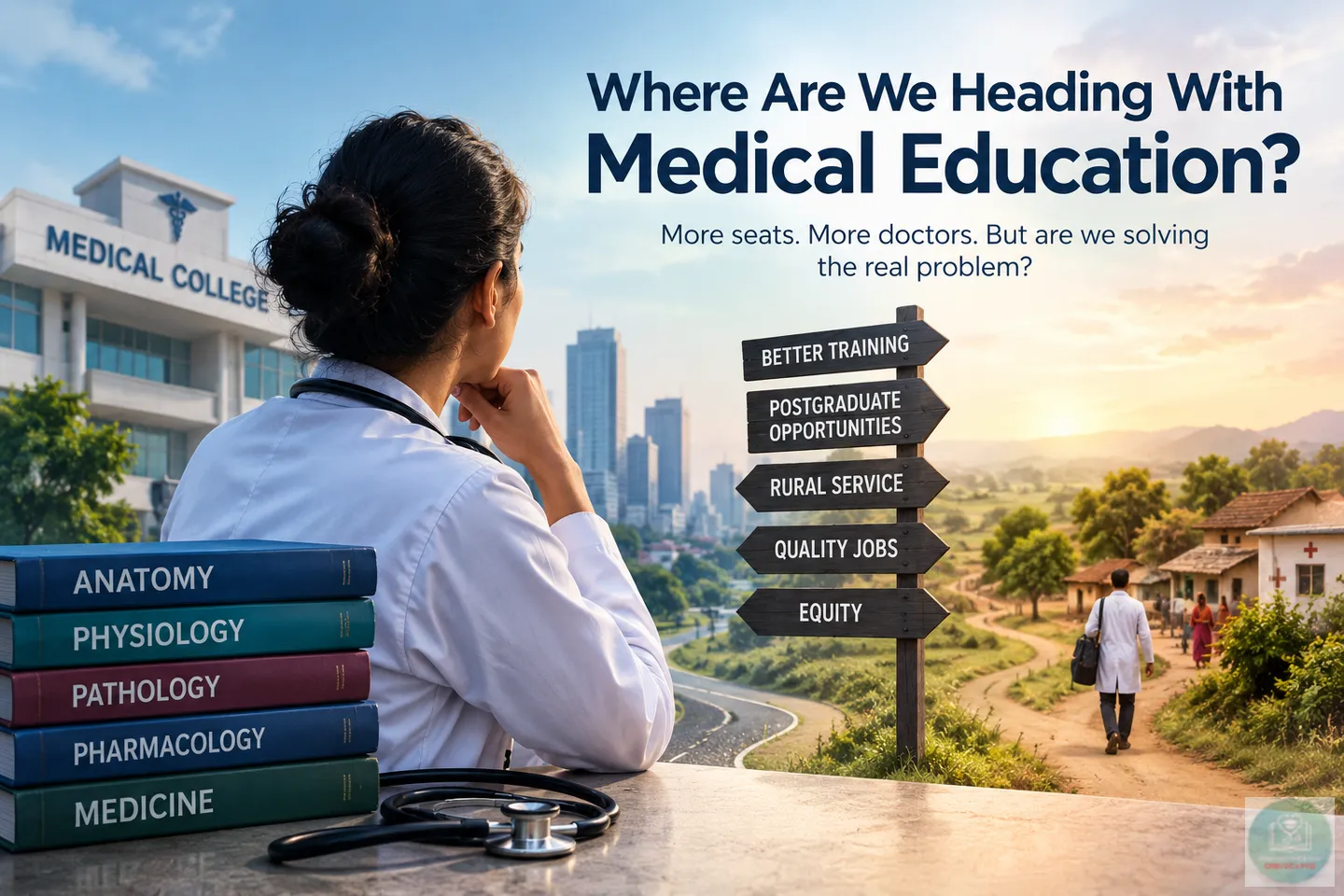
More medical colleges. More MBBS seats. More doctors.
Sounds like good news. And it is. But then comes the slightly uncomfortable question:
By a doctor who has spent enough years in medicine to remember when getting an MBBS seat was the beginning of the struggle—not the beginning of a financial calculation.
If we are producing so many more doctors, why does rural India still struggle to find doctors?
And another one:
If there are so many medical seats, why are young MBBS doctors increasingly worried about what they will do after graduation?
Somewhere between these two questions lies a much bigger story about the future of medical education in India.
The issue is not that India is producing more doctors.
India needs more doctors. The issue is whether we are increasing the number of medical seats faster than we are increasing the capacity to produce good doctors.
And those are two very different things.
Once upon a time, getting an MBBS seat was the problem, students struggled to even get a MBBS seat
There was a time when the biggest question after NEET was:
“Which medical college did you get?”
Today, there are several additional questions:
- “Government or private?”
- “Management or NRI?”
- “How much is the annual fee?”
- “How much will the entire MBBS cost?”
And increasingly:
“What will I do after MBBS?”
That last question is becoming particularly important.
India has dramatically expanded its medical education capacity. MBBS seats increased from 83,275 in 2020–21 to 1,15,900 in 2024–25, according to data presented by the government in Parliament. [Indian Express]
And the expansion has continued. The government has announced plans for tens of thousands of additional medical seats, including a much-publicised target of 75,000 additional undergraduate and postgraduate medical seats over five years. [PIB] [PM India – Cabinet Announcement]
On paper, this sounds wonderful. But medicine has one small problem:
You cannot manufacture a competent doctor by manufacturing a medical seat.
Lets look at the Rajasthan state UG counseling!
The current Rajasthan NEET-UG counselling is difficult to ignore. It provides an interesting snapshot. The official counselling portal has been publishing revised vacancy and seat matrices through successive rounds. [Rajasthan NEET UG Counselling – Official]
We should be careful about saying that “approximately 3,000 seats are still vacant after the second round alone in Rajasthan.” [Careers360]
But the broader phenomenon is real. Government data showed that 2,849 MBBS seats remained vacant nationally in 2024–25, even though MBBS capacity had increased by around 39% from 2020–21. [Indian Express]
We have millions of students competing for medical education. Yet thousands of MBBS seats can remain vacant year after year. So perhaps we should ask ourself few questions?
“Are students losing interest in medicine?”
“Why are some medical seats becoming difficult to fill despite medicine remaining one of India’s most sought-after professions?”
The answer may involve fees, location, infrastructure, perceived quality, clinical exposure and—very importantly—what happens after MBBS.
The elephant in the white coat: What happens after MBBS?
For many young doctors, MBBS is no longer seen as the destination. It is the beginning of another competition: NEET-PG.
And here lies one of the biggest contradictions in our current system. We are rapidly increasing the number of MBBS graduates. But appropriate and desirable postgraduate training remains highly competitive and unevenly distributed.
A 2024 Parliamentary Standing Committee report noted that around 68,000 PG seats were available for more than two lakh PG aspirants in 2023–24. [PRS]
The situation becomes even more interesting when we look at more recent counselling data. According to Medical Counselling Committee data reported by The Indian Express, the number of vacant PG seats after the first round of counselling increased from 11,629 in 2021 to 17,619 in 2025. [Indian Express – PG vacancies]
So we have a rather strange situation: More PG seats. More MBBS graduates.
Yet thousands of PG seats can remain vacant while thousands of MBBS graduates are still desperately trying to secure postgraduate training.

How is that possible?
Because a “PG seat” is not simply a PG seat.
- Specialty.
- Location.
- Government or private.
- Fee.
- Bond.
- Stipend.
- Infrastructure.
- Clinical workload.
- Future prospects.
All matter.
A seat in a specialty that a candidate does not want, in a location they cannot afford to live in, at a fee they cannot afford to pay, is not necessarily a meaningful solution to the PG bottleneck.
The junior doctor dilemma
Imagine a student who spends:
- Two years preparing for NEET-UG
- Five-and-a-half years completing MBBS and internship
- few more years preparing for NEET-PG
- Potentially several more years completing MD/MS/DNB
- Then perhaps another few years pursuing super-specialisation
By the time this person becomes an established specialist, a significant portion of their twenties may have disappeared into examinations and training.
Now imagine telling the same person after MBBS: “Don’t worry. You are a doctor. You will find something.”
That may have been reassuring twenty years ago. Today, it needs a little more explanation. Because an MBBS degree does not automatically provide the career trajectory that society assumes it does.
Are we heading towards an MBBS unemployment problem?
This is where the discussion becomes uncomfortable. It would be incorrect to say that India has already reached a point where MBBS doctors as a whole are unemployed. But there is increasing concern about underemployment, inadequate remuneration and career bottlenecks among MBBS graduates who do not immediately obtain postgraduate training.
The Economic Survey 2024–25 itself makes an interesting observation. It notes that market estimates put remuneration for fresh medical graduates at around ₹5 lakh per year, while also warning that the availability of meaningful work and commensurate remuneration could decline as the number of doctors increases. [Economic Survey 2024–25]
That is a remarkable statement to find in an official economic document.
The problem is therefore not simply: “Will there be enough doctors?”
It is also: “Will there be enough good-quality jobs and meaningful clinical roles for all the doctors we are producing?”
And that is a completely different question.
And then there is rural India
Here comes the biggest paradox of all. If India is producing so many more doctors, why are villages still short of doctors?
The answer is not that India has no doctors. The problem is where those doctors are. The Parliamentary Standing Committee on Health has specifically highlighted this geographic imbalance.
A recent committee report noted that despite a 151% increase in MBBS seats over the last decade, rural India continued to face a severe shortage of medical specialists. It cited an approximately 80% shortfall of specialists in rural Community Health Centres (CHCs) and noted that many MBBS graduates remain concentrated in urban areas or are unemployed. [PRS]
Read that again. 151% increase in MBBS seats. And still: around 80% specialist shortage at rural CHCs.
This tells us something very important.
The problem was never simply the number of doctors. The problem is also distribution.
We have an urban doctor problem and a rural doctor problem at the same time
India can simultaneously have: Too many doctors in one place and too few doctors somewhere else.
It sounds contradictory. It isn’t.
A doctor in Delhi cannot physically run a clinic in a village in Rajasthan. A specialist sitting in Bengaluru does not solve the shortage of specialists at a rural CHC in Bihar. A medical college in a metropolitan city may have hundreds of applicants fighting for a seat, while a district hospital several hundred kilometres away struggles to attract experienced faculty.
This is why simply increasing the number of medical seats cannot solve India’s healthcare distribution problem.
The rural specialist shortage is getting worse
The numbers are particularly concerning for specialists. According to analysis of government data by PRS, 68% of specialist positions—surgeons, physicians, paediatricians and gynaecologists—at rural CHCs were vacant in 2023. [PRS 2026]
Another analysis of health-sector data found that the shortage of specialists in rural CHCs had risen dramatically over the years. [PRS 2025]
So we have a peculiar situation: The country is producing more MBBS doctors. But the places that need doctors the most still struggle to attract them. At the same time, young MBBS doctors in cities are competing intensely for postgraduate seats. Something in the system is clearly not connecting.
Why don’t doctors simply go to rural India?
This is a another debate altogether, which may take a whole new post. But to summarize:
This is where it is easy to blame doctors. A young doctor is not necessarily refusing rural service because they are unwilling to serve society.
Ask a young doctor to move to a rural area and the questions are practical:
- Where will I live?
- What about my spouse?
- What about my children’s schooling?
- What about specialist colleagues?
- What about emergency backup?
- What about investigations?
- What about medicines and equipment?
- What about career progression?
- What happens to my professional development?
And perhaps the biggest question:
Will I be working in a properly functioning healthcare system—or simply be expected to manage everything with very limited resources?
These are not unreasonable questions. If we want doctors in rural India, we need to make rural practice professionally attractive.

The real shortage may be of the right doctor in the right place
Perhaps our healthcare planning has been looking at the wrong number.
We keep counting: Doctors per population.
But perhaps we should also count: Doctors per underserved population.
The Economic Survey 2024–25 itself acknowledges the skewed geographical distribution of healthcare professionals and recommends incentives, infrastructure and professional opportunities to attract doctors to underserved regions. [Economic Survey 2024–25]
Meanwhile, we are building more medical colleges
There is nothing inherently wrong with this. In fact, many of these colleges are badly needed.
New medical colleges can bring:
- Hospitals
- Specialists
- Diagnostic services
- Emergency care
- Nursing education
- Allied health training
- Research
- Better healthcare access
to previously underserved areas.
The problem begins when opening a medical college becomes the achievement rather than improving the healthcare ecosystem around it.
A medical college needs more than:
a building + beds + students + a signboard.
It needs teachers, patients, laboratories, clinical workload, academic culture, research. It needs a hospital that actually functions as a hospital.
A medical college without patients is basically a very expensive coaching centre
A 2025 investigation by Careers360 reported concerns at some newly established government medical colleges involving faculty, teaching space, cadavers, equipment and clinical material. [Careers360]
Again, this does not mean every new medical college is deficient. But it highlights an important principle: The number of seats is an input. The competence of the graduate is the outcome. And the two should never be confused.
The economics of becoming a doctor has changed
Medical education is becoming increasingly expensive. The Parliamentary Standing Committee noted that the cost of medical education had increased substantially and could reach approximately ₹60 lakh to ₹1 crore in some settings. [PRS – Cost of Medical Education]
And Rajasthan offers an interesting example.
In 2025, RajMES revised its NRI fee structure. The annual NRI fee was reduced from around ₹31 lakh to approximately ₹23.9 lakh. The Times of India reported that the state expected the move to generate approximately ₹45 crore in additional revenue by helping fill seats. [TOI – RajMES NRI Fee]
Ans that is not all, Government is also adding NRI seats in Government Medical Colleges like Kota, Udaipur and Ajmer also.
There is nothing inherently wrong with recovering the cost of medical education.
- Medical colleges are expensive.
- Hospitals are expensive.
- Equipment is expensive.
- Faculty need to be paid.
One thing seems clear: in the race to expand the number of medical colleges and increase undergraduate (UG) and postgraduate (PG) seats, the government may have reached the limits of its available budget. As a result, further expansion of government-funded medical seats is becoming increasingly difficult.
But we should still ask:
Are we slowly moving towards a system where the ability to pay is becoming almost as important as the ability to compete?
That is a legitimate question.
The merit-versus-money dilemma
NEET was introduced to create a common entrance examination. But admission does not end with the examination. After the rank comes the question of:
Which seat can you actually afford?
A highly meritorious student from a middle-class family may find some private seats financially impossible. A less competitive student from a financially stronger family may have more options. This does not mean wealthy students cannot become excellent doctors. They absolutely can.
But it does mean that the economic barrier to medical education deserves serious attention. Because if medicine becomes progressively more expensive, we risk narrowing the socioeconomic diversity of the medical profession.
And that would be unfortunate. Medical studies is a long and complex process of learning and training. By constantly lowering the cutt off marks may open the gates to such candidates who may not be able to cope with this long and tiring journey, but gets admission just because he can afford the hefty fees.
A good doctor should be selected because of ability, character and commitment—not because their family happened to have an additional ₹50 lakh available.
And then we lower the cut-off
This is another part of the story that deserves nuance. The NEET-UG qualifying percentile and the actual score required to obtain a government MBBS seat are completely different things. The qualifying score varies from year to year depending on examination difficulty and candidate performance.
For example, the General/EWS qualifying score range was: 2023: 720–137, 2024: 720–162, 2025: 686–144. [NTA – NEET-UG 2024]
So we should not casually say: “The MBBS cut-off has fallen every year.”
However, there is a larger issue. At the postgraduate level, substantial lowering of qualifying thresholds has occurred in response to large numbers of vacant seats. In 2025, after thousands of PG seats remained vacant, the qualifying percentile was reduced dramatically, including zero percentile for certain categories. [Indian Express – NEET-PG Vacancies & Cut-off]
Are we lowering the entry threshold because society needs more doctors—or because we have created more seats than the system can naturally fill?
Those are very different reasons.
We should stop counting only seats
This may be the most important point in the entire discussion. Every year we celebrate:
“X new medical colleges approved.”
“Y thousand MBBS seats added.”
“Z thousand PG seats increased.”
These are useful numbers. But they are not enough. Perhaps every medical college should also publish: Clinical exposure per student, How many teachers are actually available for bedside teaching, How many procedures does an undergraduate actually observe or perform under supervision, Are interns learning—or simply filling duty rosters, What happens to graduates after MBBS???
Because a seat is not a doctor
This is the central mistake we may be making. A medical seat is not a doctor. A medical graduate is not automatically a competent clinician. And a national doctor-population ratio does not automatically mean that a rural patient has access to a doctor.
To make a good doctor, we need good and adequate teachers, good labs, good and appropriate clinical material.
We need to stop confusing: capacity with quality
and:
quantity with distribution.
So, where are we heading?
Hopefully, towards a system that understands that medical education is not an assembly line. India absolutely needs more doctors.
The expansion of medical education has brought opportunities to thousands of students and medical facilities to regions that previously had limited access. That should be acknowledged.
But expansion cannot become the only objective. Because if we create thousands of additional MBBS seats without adequate faculty, clinical exposure and hospital infrastructure, we risk compromising education.
If we create more MBBS graduates without proportionately expanding meaningful postgraduate opportunities and employment pathways, we risk creating a growing pool of frustrated young doctors.
And if medical education becomes increasingly expensive, we risk making the profession less accessible to talented students from ordinary families.
The final question
After all these years, perhaps the most important question about medical education is not: It is to produce competent doctors who can take care of patients—and to make those doctors available to the people who need them.
India does need more doctors. But perhaps what India needs even more is a better answer to three questions:
- Where should those doctors be?
- How should they be trained?
- And what happens to them after MBBS?
Until we answer those questions, adding another medical seat may be progress on paper.
But medicine, as we all know, is practised off the paper.
Discover more from The Quirky Doctor
Subscribe to get the latest posts sent to your email.